Abstract
Isolation boundary, creepage distance and clearance determine safety test results of a USB charger. Limits vary by voltage class and pollution degree. Many designs meet clearance but fail creepage requirements or use low CTI materials, which degrade after damp heat aging. Designers need to distinguish functional, basic and reinforced insulation, apply PCB slots, barriers and insulation film, and align AC/DC hipot parameters for North America and EU certification.
1. Insulation Classification and CTI Selection
For USB charger, reinforced insulation is usually applied for accessible output. Plastic and PCB substrate with CTI ≥400V for pollution degree 2, overvoltage category II are preferred. Low CTI materials easily fail tracking test under humid conditions.
2. Creepage and Clearance Control
For reinforced isolation between AC input and low-voltage output, minimum creepage is 6.4mm and clearance ≥3.2mm. Slots ≥1.5mm are cut on PCB across isolation zone to extend surface leakage path.
3. Transformer Bobbin and Winding Isolation
Double insulation bobbin is adopted. 0.1mm isolation tape is wrapped between primary and secondary windings. Pre hipot test is performed after winding encapsulation to catch hidden wire insulation damage.
4. Hipot Test and Damp Heat Aging
Production hipot test: AC 3000V, 60s, leakage current ≤10mA. Type test includes 48h conditioning at 40℃, 93%RH, hipot test finished within 1 hour after conditioning.
5. Change Control and Certification Filing
Any modification of insulation material, bobbin or PCB slot must be filed with certification bodies. Sampling level AQL 0.65 is applied for routine hipot inspection.
Conclusion
Insulation safety is the baseline for USB charger certification. Creepage, CTI, isolation structure and damp heat test are equally important. Simsukian carries out safety pre-review at schematic and tooling stage to pass UL and CE certification smoothly for global customers.
FAQ
Q1: What certifications can Simsukian provide?
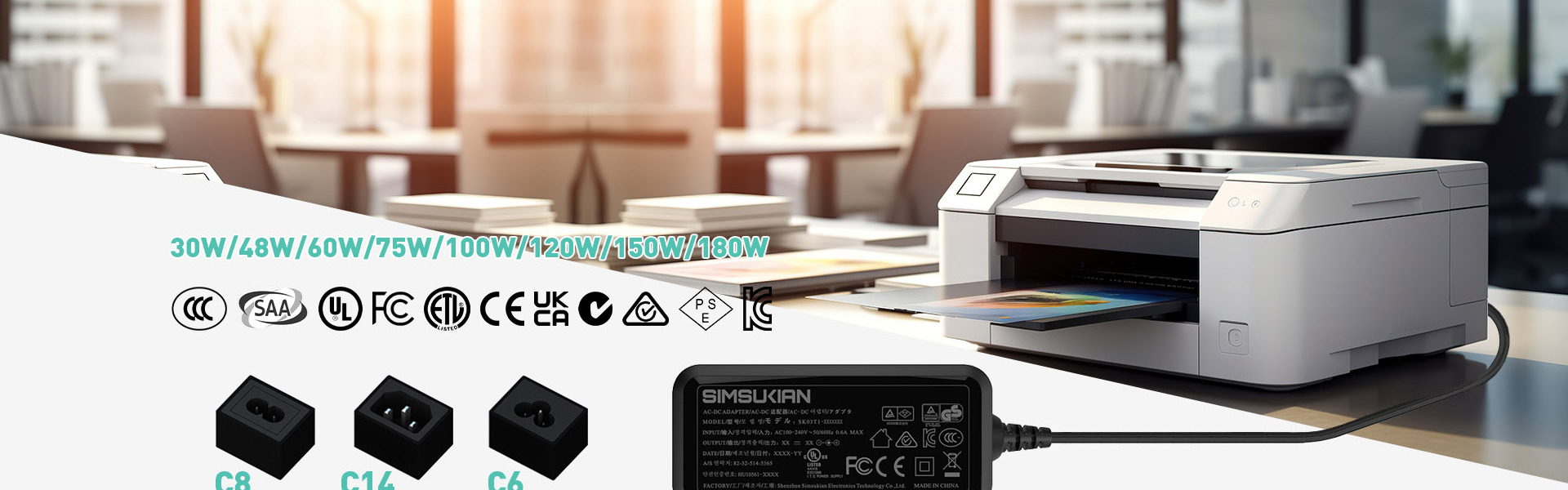
A1: Simsukian offers CCC, CQC, UL, ETL, CB, CE, UKCA, FCC, KC, KCC, PSE, SAA, RCM, EAC, PSB, BSMI, ST, RoHS, REACH, ERP, DOE VI, CEC, GEMS and KMEPS certificates. We also hold ISO9001 and ISO14001 system certifications.
Q2: What about quality consistency and protection features?
A2: All Simsukian products undergo 100% burn-in testing. Built-in multi-protection includes over-voltage, over-current, short-circuit and over-temperature protection. Features low ripple and low heat generation, with an average lifespan of around 50,000 hours for stable full-load operation.
Q3: Is customization available? What are the lead times for samples and mass production?
A3: OEM/ODM customization is supported, covering voltage, current, connectors, plugs, housings, logos and more. Sample lead time: 5 days. Mass production normally takes 20–25 days. Sample cost can be refunded after placing bulk orders.
Q4: What is the MOQ?
A4: Standard products have fixed MOQs. MOQ for custom designs is negotiable based on the solution. Please contact our sales team for details.
Q5: How do you guarantee lead time, MOQ and after-sales service?
A5: As the original manufacturer, we stock many standard items and maintain reliable lead times. Standard warranty: 1-year free repair, plus lifetime support. After the first year, only material and labor fees apply.
References
1. Simsukian Official Website: https://www.simsukianpower.com
2. IEC 62368-1:2018: https://www.iec.ch
3. UL 62368-1: https://www.ul.com