

Abstract
Switching nodes and the transformer are main noise sources in a wall-mount power adapter. The wall-mount power adapter must meet both conducted and radiated emission limits. ESD and burst immunity levels are equally mandatory for market access of the wall-mount power adapter.
1. Conducted Emissions and Input Filtering
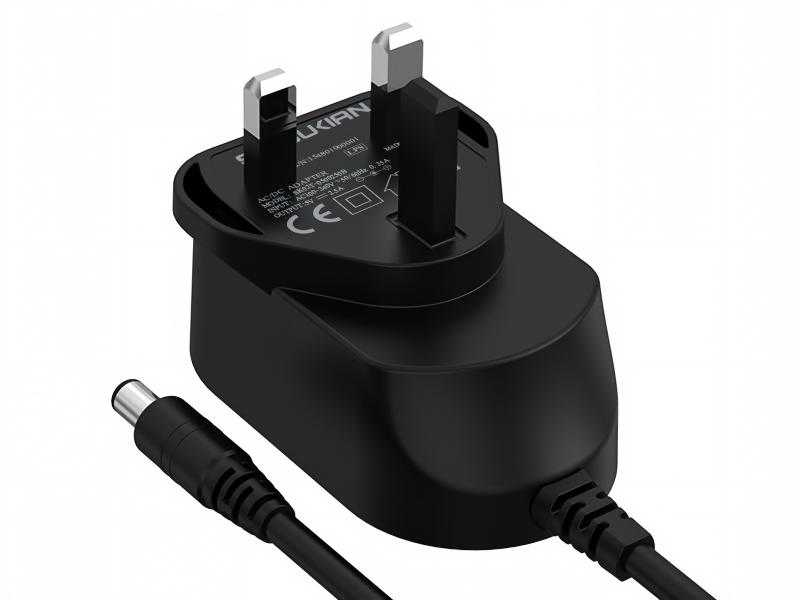
Conducted emissions of the wall-mount power adapter are measured over the specified frequency band, with quasi-peak and average limits applied together. Class B is stricter than Class A, and products for home and office terminals are usually designed to Class B. Noise comes from dv/dt and di/dt at switching edges and from rectifier reverse recovery. The wall-mount power adapter uses common-mode chokes with X and Y capacitors; filter insertion loss must match the noise spectrum, and conducted noise of the wall-mount power adapter is usually worst at low line and full load.
2. Radiated Emissions and Switching Node Layout
Radiated emissions depend on current loops and antenna effects, with power loop area, transformer leakage flux and output rectifier paths as main contributors in the wall-mount power adapter. Layout shortens high di/dt loops, minimises switching node copper and adds insulation or shielding between devices and heatsinks. With a plastic housing, radiation of the wall-mount power adapter leaks mainly through cables and seams, so output cable length and shielding change results markedly and must be fixed during testing.
3. ESD, Burst and Surge Immunity Levels
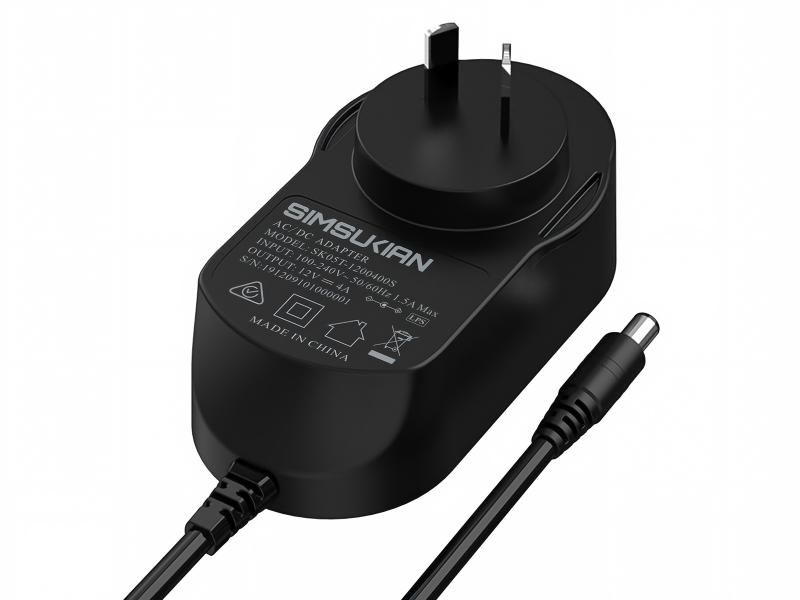
Common immunity tests include electrostatic discharge, electrical fast transients and surge, with levels set by the standard; contact and air discharge are applied separately, while burst and surge cover AC and output ports. Pins of the wall-mount power adapter connect directly to the mains, so surge energy hits the input first and varistor plus gap coordination defines clamping. The wall-mount power adapter must not suffer permanent damage, and acceptable temporary disturbance must be agreed with the buyer in advance.
4. Voltage Dips, Short Interruptions and Recovery
Grid fluctuation causes output dips or shutdown of the wall-mount power adapter, and immunity standards define dip depth, duration and phase. After the dip the wall-mount power adapter should recover automatically without latch-up, repeated restart or output overshoot. Applications with controllers also need hold capability of the wall-mount power adapter during interruption so configuration is not lost.
5. Test Setup, Margin and Corrective Path
EMC results are highly sensitive to setup: height, grounding, cable routing and chamber background noise all shift readings of the wall-mount power adapter. Sufficient margin is advised before mass production; a marginal wall-mount power adapter may exceed limits once core batch or winding process varies. Corrective work starts at the noise source before retuning the filter, since enlarging Y capacitors in the wall-mount power adapter raises leakage and requires a safety re-check.
Conclusion
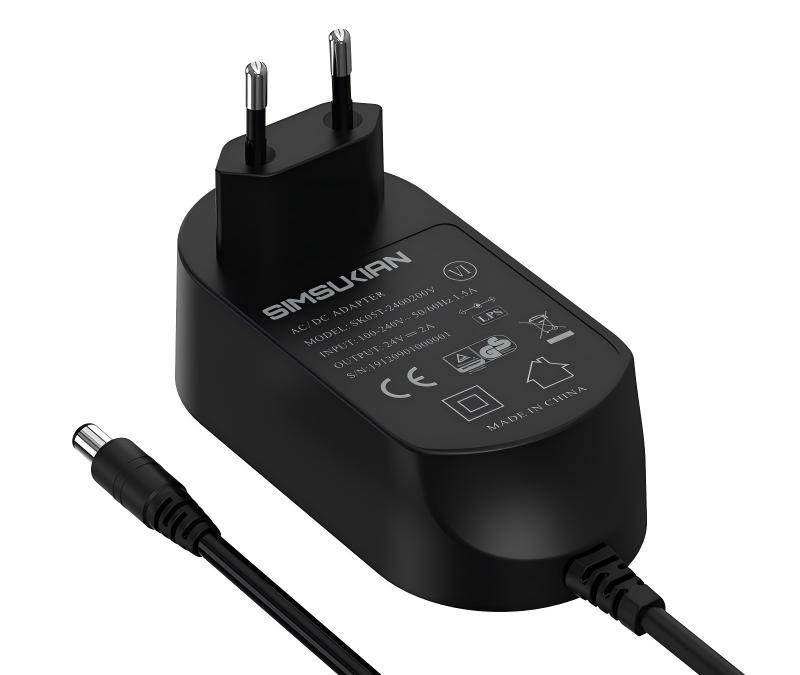
EMC design of a wall-mount power adapter results from source suppression, filter network and mechanical layout together; adding parts late rarely gives stable compliance. Simsukian provides EMC pre-testing against EN 55032 and EN 55035. Overseas buyers are welcome to contact Simsukian to confirm test and corrective plans.
FAQ
Q1: Are the certifications complete and verifiable?
A1: Simsukian’s full product range covers major certifications including UL, CE, FCC, PSE, KC, SAA, UKCA, and CB. All certificates can be verified through official channels, effectively avoiding risks of fake, borrowed, or expired certificates that may cause customs clearance failure or platform delisting.
Q2: How is the quality stability and protection performance?
A2: All Simsukian products undergo 100% aging tests and are equipped with multiple protections including over-voltage, over-current, short-circuit, and over-temperature protection. They feature low ripple, low heat generation, and an average lifespan of approximately 50,000 hours, supporting long-term full-load stable operation.
Q3: Can products be customized? What are the sample and mass production lead times?
A3: OEM/ODM customization is fully supported, including voltage, current, connector, plug type, housing, and logo. Sample lead time is 5 days. Standard bulk order lead time is 18–20 days. Sample fees are refundable after placing a bulk order.
Q4: Do the products meet energy efficiency and standby power requirements?
A4: The full range meets DOE Level VI and higher energy efficiency standards. Some models achieve no-load power consumption ≤0.1W, complying with ErP and other international energy-saving regulations.
Q5: How are lead time, MOQ, and after-sales service guaranteed?
A5: As a source manufacturer with abundant stock of standard models, delivery is stable. Standard warranty is 1 year (free repair within the first year). Lifetime repair support is provided; after the first year, appropriate material and labor fees will be charged.
References
1. Simsukian Official Website
2. EN 55032 Electromagnetic compatibility of multimedia equipment – Emission requirements
3. EN 55035 Electromagnetic compatibility of multimedia equipment – Immunity requirements
Power adapter
Power adapter
Related Articles More>>
- PD GaN fast charger EMI Suppression and Clean Output Technology
- Protection Mechanism and Fault Latch & Reset Logic of Plug-in Power Adapter
- PD GaN fast charger PDO Protocol Adaptation and Intelligent Handshake Technology
- Output Cable and Connector Matching for Power Adapter: Wire Gauge, Drop and Contact Resistance